In the deserts around Palm Springs, you’ll find renegade artworks that reflect the rugged, forsaken nature of the landscape itself. This is a story about art in all its forms — and all its interpretations.

By Yourgo Artsitas
Journalist, Documentarian, Roving Correspondent
Palm Springs has a wealth of public art. It’s on the sidewalks and in the squares: sculptures, murals, installations, and molds. And the buildings themselves, some of the finest examples of mid-century modern architecture in the world, might be the town’s greatest artworks of all. Even at my hotel, the rustic Sparrows Lodge, there were one-of-a-kind pieces in both the rooms and public spaces.
As well decorated as the city is, the art fits into a meticulously curated, high-gloss, Palm Springs modern aesthetic. Lest you forget, you’re in the desert: vast, dry, unforgiving. And appropriately, out in the more remote reaches of that wilderness, you’ll find art to match the ruggedness of the region and the forgotten, forsaken nature of the landscape itself.
Just like the art in Palm Springs, the open-air desert galleries are free for the public to enjoy. Where they differ mostly is in the materials used and messages sent. Recycled trash and imperfect objects are popular choices, and independence from organized society is often the muse. The works are frequently judgmental of our institutions, and occasionally antagonistic toward the viewer.
I visited a handful of these improvised outsider art exhibits. Truth be told, I didn’t love everything I saw. Nor did I love all the places I had to go. But fair is fair. Unlike the customary museum experience, you can be certain that the outsider artist’s response to someone saying “I don’t get it” is “I don’t give a fuck.” And that semi-adversarial arrangement is what gives the pieces much of their power.
Here are four spots within driving distance of Palm Springs that prove that even in the desert heat, you can find something cool. And if you don’t think it’s cool, hey, that’s okay.
Explore our picks for the best boutique hotels in Palm Springs.
GALLETA MEADOWS: “Open to the Public”
We start with the most traditional of the locations I visited, which wasn’t very traditional at all.
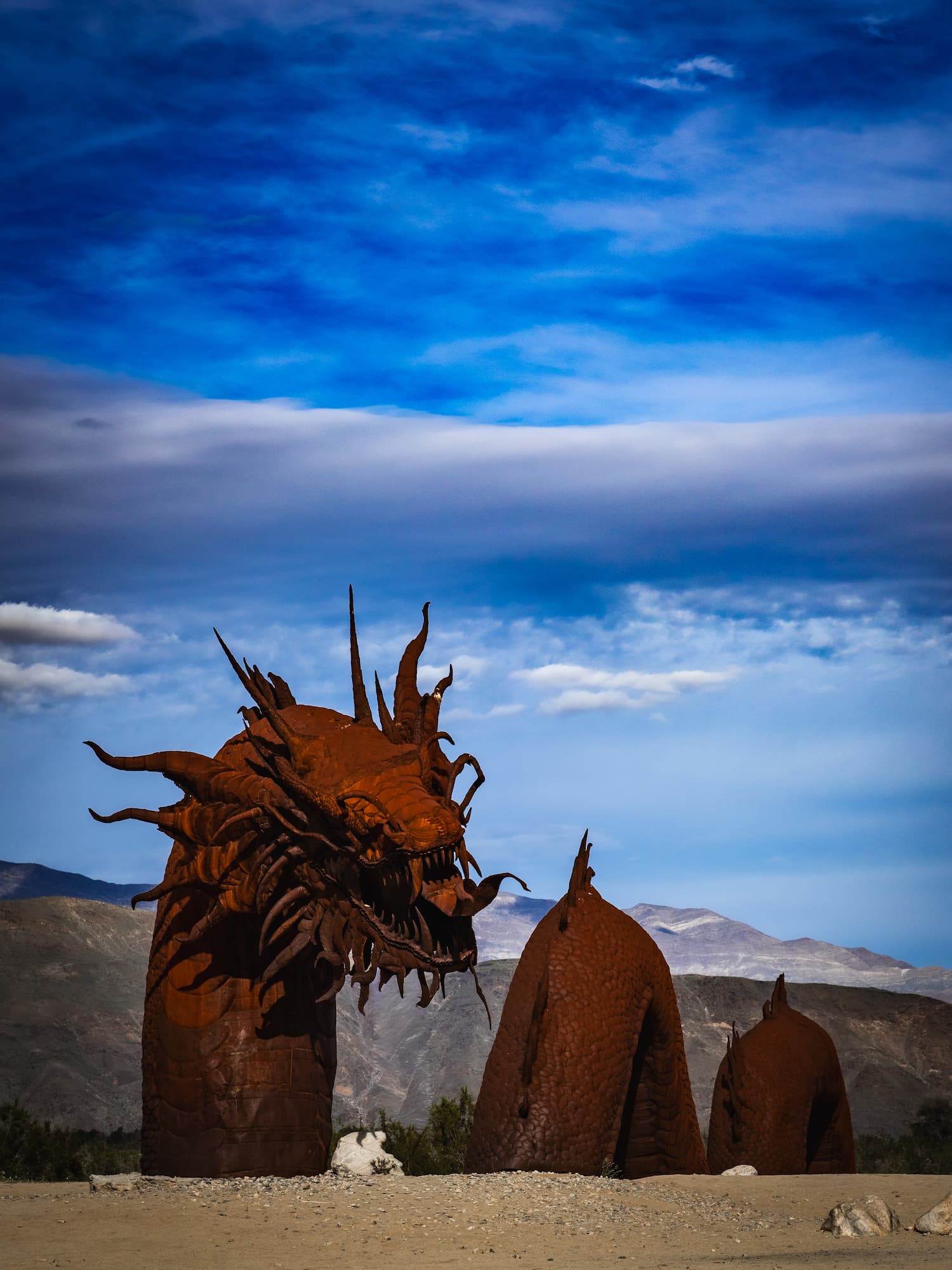
A few miles past the Texas Dip, an undulating hump of California desert highway made famous by the chase sequence from One Battle After Another, you’ll find monsters standing in broad daylight. Dinosaurs, giant scorpions, a saberwolf, and other things you can’t even identify. And then there’s the serpent, a 350-foot dragonsnake with a spine that goes in and out of the sand and spans across the road.
This is Galleta Meadows in Borrego Springs, a park with over 130 steel sculptures scattered amongst the brush, all made by Ricardo Breceda, “the Picasso of steel.” Breceda is a Mexican immigrant who got a peculiar request from his daughter. She’d just seen Jurassic Park III and wanted a dinosaur for Christmas. Breceda came back with a 45-foot long, 20-foot high Tyrannasaurus Rex.
Breceda was serious enough about his new hobby that he opened a studio in the town of Perris, located in SoCal’s Inland Empire. One day, millionaire Dennis Avery was driving by. He’d bought 3,000 acres of the Borrego Springs Valley in the 1990s and thought Breceda’s steel sculptures would be right at home there. So he hired Breceda to make more, and to help turn his valley into the prehistoric wonderland you can visit today for free, 24 hours a day.
And now, on to exhibitions far less genteel than these rusted steel predators.
BOMBAY BEACH: “Greetings from Salton Sea”
Back in the 1950s and 1960s, an hour or so south of Palm Springs, Bombay Beach was a hotspot, drawing celebrities from Frank Sinatra to the Beach Boys. They’d come to waterski, boat, and fish on the Salton Sea, a terminal lake created a few decades earlier thanks to an engineering snafu that diverted Colorado River floodwaters into the Salton Sink basin.
With no outlet other than evaporation, the stagnant lake, filling with chemicals from agricultural runoff, became twice as salty as the ocean. In the 1980s and 1990s, wildlife perished at an alarming rate, with around 97% of the fish dying. The smell of rotting fish, combined with toxic air from the increasingly exposed seabed, had most residents and resorts abandoning the place.
Now Bombay Beach is home to around 300 people, mostly in mobile homes. And I’m honestly surprised it’s that high. Not because the closest hospital is 45 minutes away, or the nearest gas station is 20 miles away. But because Bombay Beach holds the unfortunate distinction of being the lowest community in America at 223 feet below sea level. And that, along with the salt, make the beach unbearably hot. The day I was there it was 109°, but felt a hell of a lot hotter.
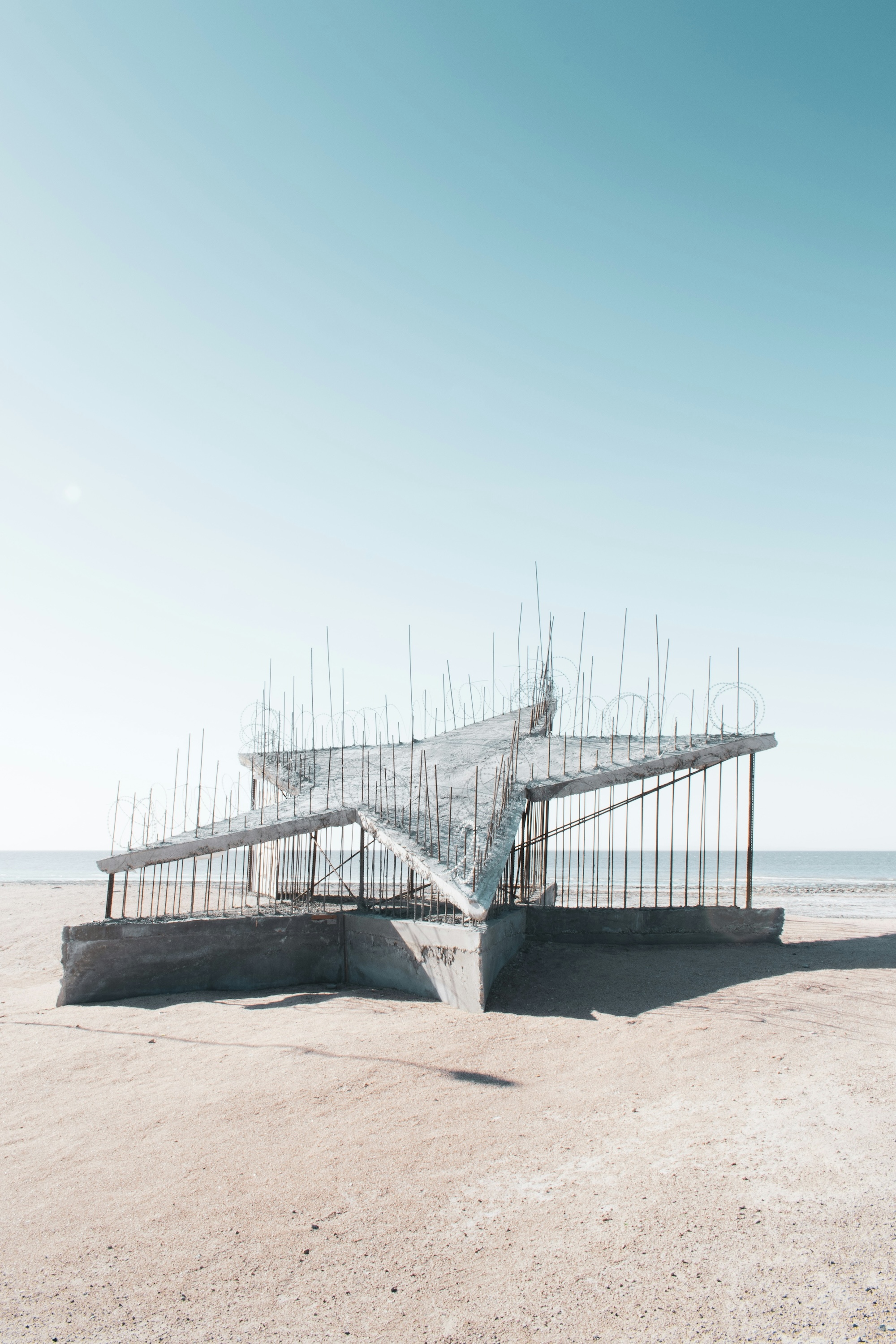
Despite all that, artists have chosen to take their art there. And the worst part is that the art is good. Interesting stuff is everywhere. A giant star made out of rebar overlooks the sea. A full-sized pirate ship sits perfectly crashed on a cliff. A Loch Ness monster tentacle springs from the sand near the shore. And a replica of Oppenheimer’s bomb sits on…..wait for it…. BOMBay Beach. There’s a thriving arts community here. They even have their own biennale.
Incredible stuff in a sometimes insufferable place.
SLAB CITY: “The Last Free Place”
Remote. Unincorporated. “The Last Free Place in America.”
That’s the motto of Slab City, a so-called squatters’ paradise not too far from Bombay Beach. It’s here, among old concrete slabs from a decommissioned military base, that an off-the-grid community — and their improvised art — survives.
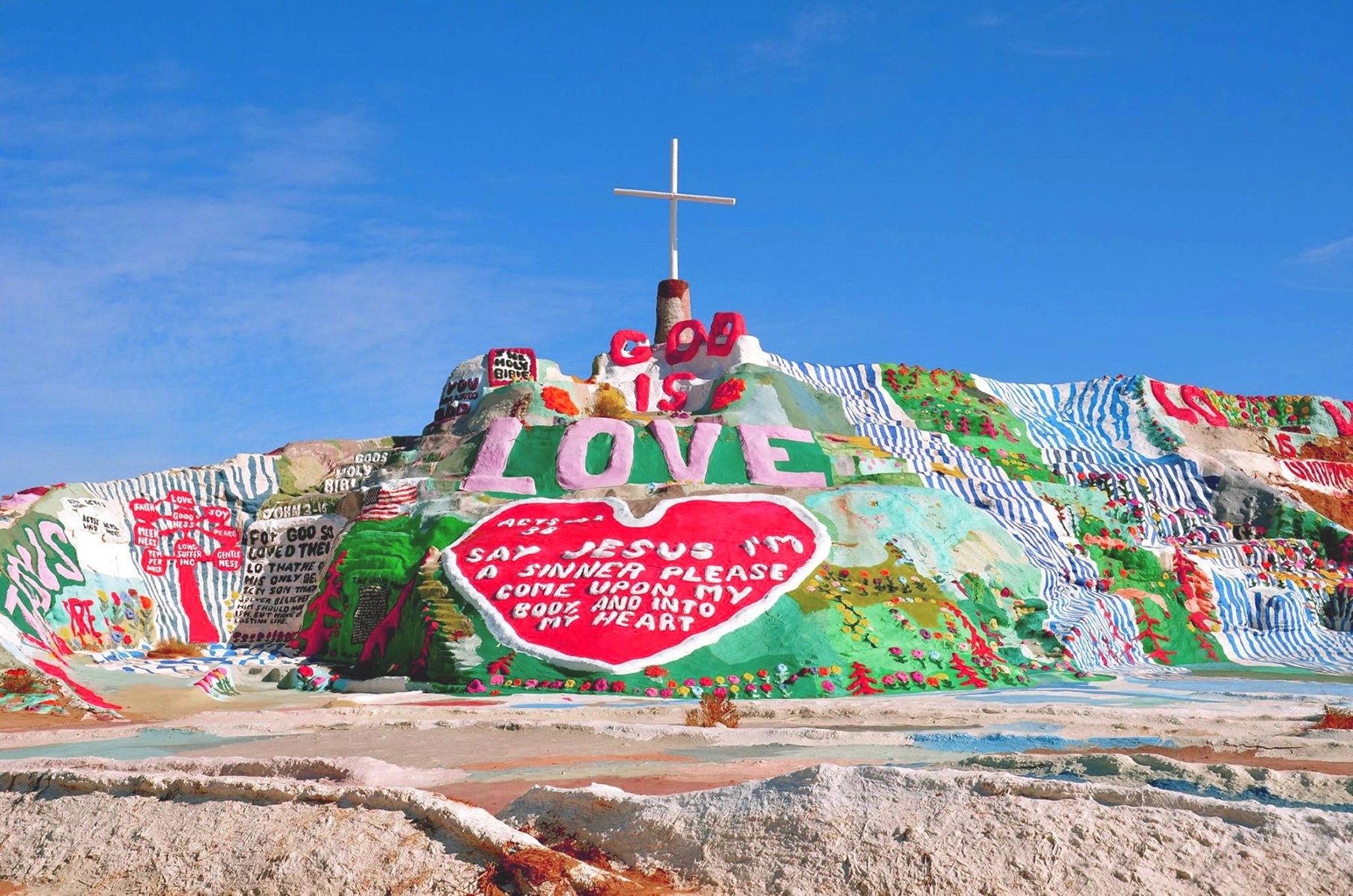
On the way in to Slab City, you see Salvation Mountain. A gigantic mural on a mountain made by Leonard Knight. You might remember it — and him — from an important scene in Sean Penn’s 2007 film Into the Wild. With half a million gallons of latex paint, Salvation Mountain acts as a de facto welcome sign to Slab City. It’s overtly religious in its messaging and utterly massive in scope. It took 28 years to make, it’s been designated for protection by local and national organizations, and it’s the last place in Slab City you’ll see art that traditionally good.
Slab City is a rolling junkyard with trash upon trash strewn over acres and acres. I’ve seen communities in Mad Max better kept. It’s guerrilla art. A steampunk emporium of sorts, where trash is turned into slightly nicer trash. But with personality! Am I being harsh? Sure, but this is art that’s designed to be divisive.
Undeniably, there is a charm to the resourcefulness and ingenuity of the pieces. There’s an improvised R2D2 that felt worthy to be in the Chewbacchus parade in Mardi Gras. I was moved by the simplicity of a pair of Joshua trees with tied-up sneakers hanging from them like an urban light pole. But as a tourist destination, Slab City is difficult to recommend. Truly apocalyptic vibes.
NOAH PURIFOY: “One Man’s Trash”
Just north of Joshua Tree, at the Noah Purifoy Outdoor Desert Art Museum, I finally found something special. And it wasn’t the art.
Noah Purifoy mostly engages in “Junk Dada,” specializing in making art from discarded materials. Trash, basically. In a lot of ways, it’s like Slab City, just a much higher level.
But still, most of the pieces baffled me. There was a pile of old household appliances bunched up together with the title Everything and the Kitchen Sink. At first glance, it felt like the type of high-minded nothingness often pilloried when satirizing modern art. A handful of installations landed for me, like Adrian’s Little Theatre, a small white venue that was immersive and engrossing. But otherwise, not much was resonating.
As I’m about to leave, frustrated with my art comprehension skills, I run into a passerby walking his dog. His name is Al Murdy, a local who was a neighbor of Purifoy before he passed in 2004. As if he heard my complaints, he tells me a story about Everything and the Kitchen Sink. One day, Murdy walked up as the artist was positioning the junked appliances in a group. Purifoy explained to him that the outmoded appliances were meant to symbolize technological advancement, and how the obsolete gets discarded for faster, better, smaller.
My question was answered. The art I so ignorantly passed off as pretension was explained clear and concise. When I asked Murdy what his favorite piece was, his answer was a much welcomed surprise.
“The one with my bicycle.”
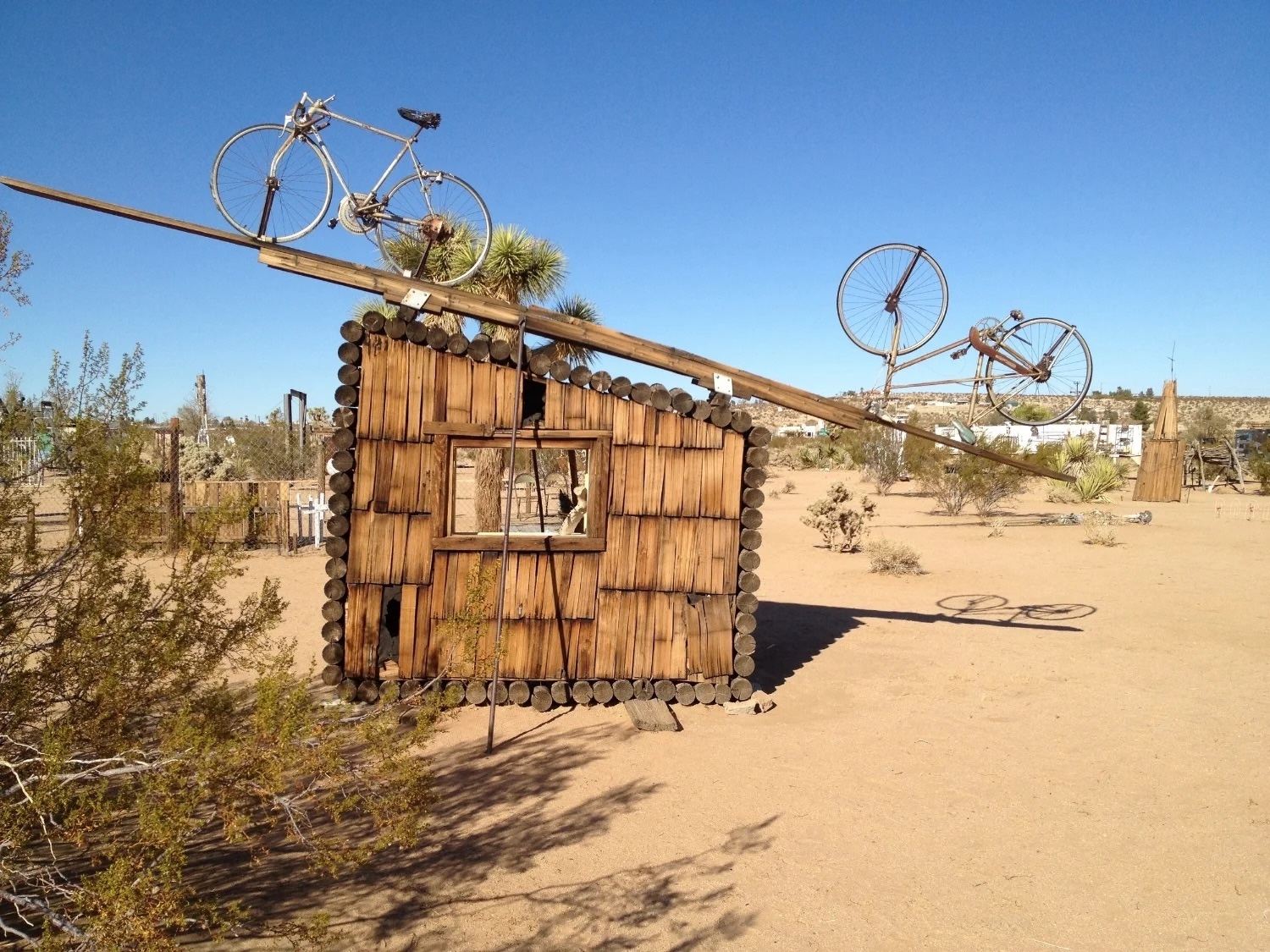
Years ago, after crashing their bikes, Murdy and his wife donated them to Purifoy. They now sit adorning the roof of a piece called No Contest. It has gone on to become one of Purifoy’s most famous and photographed pieces.
I cared more about getting the story than getting the picture.